Best Nvidia Graphics Card For Mac
As we reported earlier this morning, Nvidia has released its. These drivers make it possible to use graphics cards from the company’s popular 10-series lineup, which include the GeForce GTX 1080 Ti, among other hardware.
This release has major implications for legacy Mac Pro, and eGPU users. It means that we can now use the latest Nvidia hardware to drive our machines graphically. It means taking a relatively underpowered computer like the 13-inch 2016 MacBook Pro, and running games at high settings with respectable frame rates.
We plan on testing out the beta drivers more extensively in the future, but for quick testing purposes, we decided to try powering our 13-inch MacBook Pro with the Pascal-based GTX 1050 Ti. What we found was an encouraging sneak peek at the potential of eGPU setups on the Mac. I’m traveling right now, but I knew that Nvidia was planning on releasing its Pascal drivers this week. With this in mind, I brought the Akitio Thunder3 eGPU box that I put together for an earlier Boot Camp Windows 10 project. You can; I used this box to run games on Windows since there was no Pascal compatibility on macOS at the time.
This enclosure is super small, relatively lightweight, and fairly powerful for what it is. It made the perfect travel companion to test out Nvidia’s beta Mac web drivers.
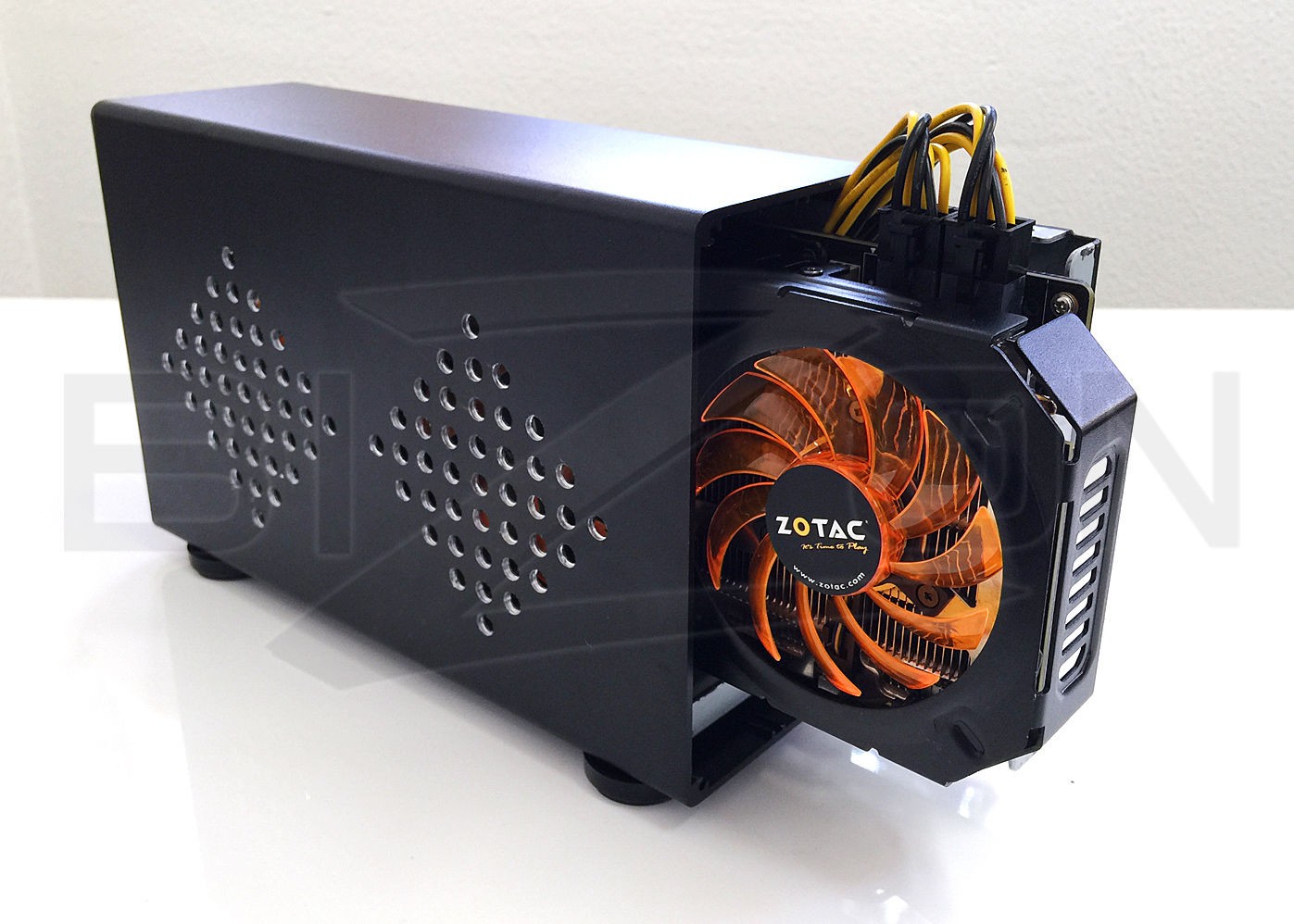
That said, I wouldn’t recommend the Akitio Thunder3 for most users, because its small size and lack of power heavily restrict the type of cards that can be used inside. You can, t, modify the case and power supply to drive larger cards, but you might as well buy a larger enclosure like the Akitio Node — another eGPU box that. Another downside of the Thunder3 is that it doesn’t feature Mac compatibility out of the box.
The Thunderbolt 3 chipset that’s used is unsupported on macOS, but it’s possible to for this chipset. Once you have the Thunder3 setup and connected to your MacBook Pro and an external display, it’s just a matter of to download the newly-released web drivers and enable the GPU on your MacBook Pro. Note that you should be running macOS 10.12.4. How to enable the Nvidia-powered eGPU on macOS 10.12.4 Open Terminal and type the following commands to download and run goalque’s script: curl -o /Desktop/automate-eGPU.sh chmod +x /Desktop/automate-eGPU.sh cd /Desktop sudo./automate-eGPU.sh Enter your password when requested and press Return.
Follow the on-screen instructions, and you’ll eventually be asked to reboot your machine. Once you reboot, you should see macOS on the externally connected display, along with Nvidia’s Driver Manager running in the menu bar. You’ll also notice that the Nvidia card shows up inside System Information under the Graphics/Displays section.
I ran a few quick before and after benchmarks using Heaven and found that even a GTX 1050 Ti made a world of difference on my 2016 MacBook Pro with integrated Intel GPU. Before (using Intel Iris Graphics 550 integrated GPU) After (Using GTX 1050 Ti via eGPU) Notice the stark difference in FPS. Using the Intel Iris Graphics 550 integrated GPU, a game with high settings is basically unplayable, whereas the eGPU setup produces respectable frame rates even with the relatively “weak” GTX 1050 Ti. Obviously this is not an extensive test, but it just goes to show at a glance the type of potential offered by an eGPU setup via Thunderbolt 3. That’s just one of the reasons why the release of Nvidia’s new Pascal drivers is so exciting for MacBook Pro owners in particular. Pascal GPUs Keep in mind that Nvidia offers a wide range of Pascal-driven GPUs. Prices range from around $99 for the 1050 all the way up to $1200 for the ridiculously powerful Titan Xp.
Most of these GPUs are available from a variety of manufacturers like EVGA, GigaByte, Zotac, and others. eGPU Boxes for more videos As mentioned, the uber-small Thunder3 box is not ideal for most setups. Not only is it too small to fit most cards, but it isn’t able to supply enough power to most cards. The GTX 1050 and 1050 Ti that I used are anomalies because their power requirements are low (75W TDP) and they’re small enough to fit inside the enclosure.
I personally like the Akitio Node, because it features a generous 400W power supply, and has more than enough room to fit large double-width GPUs. The Node also has the advantage of having the newer TI chipset that works out of the box on macOS without any hacks. Unfortunately the Node is, and has. Conclusion We’re still very early in the game, but now that Nvidia has stepped up to the plate and provided macOS drivers for its Pascal lineup, the future looks much brighter for eGPUs. There are still some obvious growing pains, such as the lack of an easy way to drive the MacBook Pro’s internal display with the eGPU, but I think that as more people show interest, the parties involved will be more willing to support our efforts. We’ll be back with additional coverage in the coming days and weeks. In the meantime, feel free to share your current and planned setups in the comment section.
Ask any console gamer, and they’ll likely tell you about the perennial rivalry between the. However, PC gamers have their own eternal feud, albeit without the headlines: Nvidia vs AMD. Although you may have never heard about it before, the sheer amount of innovation and competition that has sprung forth from this tech feud is nothing short of amazing. Still, if you’re not willing to pledge loyalty to one of these tech behemoths, it can be hard to decide what the for your needs is. Don’t worry though, we here at TechRadar have decided to sit down and figure out once and for all the true winner in the battle of Nvidia vs AMD.
(Spoiler: it never ends). In 2018, the Nvidia vs AMD battle is in an awkward position. Almost two years after the release of the Nvidia GTX 10 series, it released the architecture with the, and the. These cards are incredibly powerful, but come at such a high cost that they’re not really in the same lane as AMD’s products, which are focused more on budget users.
It frees up apps on my phone which in turn means less apps to update and allows me to pay for everything with one ecosystem regardless of if I'm using Android or Apple. I live in China now and having one app that does most everything I need is convenient. Pencipta wechat for mac.
A high cost, mind you, that. Over on the red team, AMD launched back in 2017. And, while it has launched a new GPU at, this isn’t a consumer model. So, with likely launching in 2019 or later, we don’t think AMD plans to directly compete with AMD’s turing cards. Instead, we think AMD is going to in the near future that are going to dominate the budget-focused 1080p segment of the scene. No matter how you slice it, neither Nvidia or AMD graphics cards are going anywhere, so that’s why we crafted this guide – to dive in and figure out how they differ.
From their exclusive features to price to performance ratio, even down to their drivers, and you can’t forget all those pesky exclusive features, either. There are graphics card choices for days Price Anyone who browses Reddit or comment sections on tech websites will tell you that AMD is widely known for its affordability, and Nvidia for its high-end performance and high prices. But, are they actually right? Well, there are plenty of benchmarks that pretty convincingly tell us that the AMD Radeon RX Vega 56, which is available for around $400 (about £284, AU$500) MSRP, is a better performer than the $650 (about £549, AU$799).
When you factor in the effect that has on the prices, Nvidia actually has a pretty massive advantage from a pricing perspective. However, even though cryptocurrency isn’t really an issue anymore, the new graphics cards that Nvidia just announced are priced extremely high. The is listed at $1,199 (£1,099, AU$1,899), which is almost twice the price of the last-generation.
This price bump continues down the line, with the at $799 (£749, AU$1,199) and the at $599 (£569, AU$899). During the reveal keynote, Nvidia claimed that they would start at lower prices, for instance, the 2080 Ti should be starting at $999 (about £760, AU$1,385) – but we haven’t seen any cards offered at these prices.
We’ll likely see these lower-priced units launch in a few months, if they ever launch at all. But, until then, you might want to look at the previous generation offerings on Nvidia’s side.
However, the GTX 1080 Ti, which is still more powerful than anything in AMD’s stable, is quickly running out of stock, according to a report from. Right now, the most affordable RTX card is the 2070, which is available at $599 (£549, AU$999). While that’s a far cry from the high price of the 2080 Ti, it’s still a lot to ask for a mid-range card. Instead, right now.
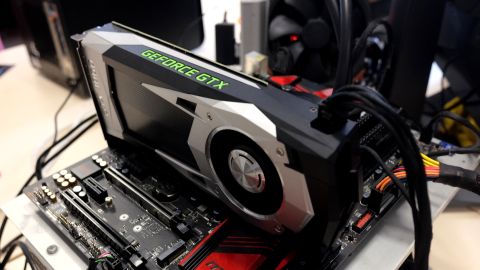
We’d recommend budget users to find a 10-series card like the Nvidia GTX 1060 while you still can. Alternatively, an AMD Vega or Radeon RX 500 series card are still pretty comparable in price and power. Right now you can find an for around $599 (£550, AU$730), about the same price as the RTX 2070 for similar performance. At the end of the day, the better price is going to depend on where you’re lucky enough to find a discount. Performance When you’re trying to that’s more powerful than your arch-enemy’s, buying a graphics card isn’t a matter of price but performance. Packing the best performance for the lowest cost is the arguably the most pertinent factor in driving GPU sales.
Right now the RTX 2080 Ti completely blows away every other consumer-grade graphics card with 11GB of GDDR6 memory and high-end Tensor and RT cores that will enable AI-controlled super sampling and real-time ray tracing. AMD right now doesn’t have anything in the same ballpark – but does that even matter? AMD have always been known for being the clear value champions, whereas Nvidia usually has more powerful hardware. AMD Vega has been out for about a year now, and while it doesn’t even compete with the, it is still a much better value. Unless you’re playing in 4K UHD or even Ultra-Wide WQHD resolutions, you’ll probably get a better value out of an AMD graphics card.
The lowest end current-generation graphics card in Nvidia’s stable is the Nvidia, with performance that matches the AMD Vega 64 in a lot of cases. And, while the prices for these two GPUs are mostly comparable, AMD is currently dominating the budget-to-mid-range product stack with cards like the Now there are rumors that AMD may introduce yet another Polaris-based GPU with the. Based on rumors, it appears to deliver near Nvidia levels of performance. At the end of the day, AMD and Nvidia are occupying completely different sides of the marketplace right now, so the best choice is going to rely on what games you’re trying to play and at what resolution. If you’re trying to play games like Assassin’s Creed Odyssey at 4K, you’re going to want to go with Nvidia. But, if you just want to play Overwatch at 1080p with a high refresh rate – go with AMD. Software, drivers and features.
One key draw to using Nvidia hardware over AMD is the Green Team’s GeForce Experience software. Because it delivers driver updates and optimizes games in addition to letting you broadcast gameplay and capture screenshots as well as videos directly from its easy-to-use interface, Nvidia GeForce Experience is posited as the one PC gaming application to rule them all.

Meanwhile, AMD’s newly announced Radeon Software Adrenalin Edition aims to overtake Nvidia’s solution. Previously known as Crimson ReLive, the latest re-skinned update of AMD’s graphics application is stacked with all of the features you’ve grown accustomed to since the UI was back in July, but with the benefit of more consistent updates driver updates to account for every major game release. As of December 2016, via Radeon Crimson ReLive, but now you can take safety measures to ensure maximum power efficiency while you’re gaming. That includes the ability to underclock memory frequencies, cap frame rates on a hardware level and enable “Enhanced Sync” to decrease frame stutter while it simultaneously combats screen tearing.
Still, GeForce Experience has the game optimization features we’re all crazy for. So when you don’t know what settings are best for your computer in The Witcher 3, Nvidia takes care of the heavy lifting for you. AMD users can download and install Raptr’s Gaming Evolved tool to optimize their gaming experience. However, the add-on is less than ideal considering its biggest rival’s audience can accomplish nearly everything from within GeForce Experience. That includes to take way cool in-game photos at resolutions exceeding 63K (16 times that of which a 4K monitor can display). Nvidia also has a leg up when it comes to streaming games whether it’s to another gaming PC with at least a Maxwell-based GPU, as well as the company’s self-made tablets and set-top box. Not to mention, Nvidia also has a cloud-based gaming service call GeForce Now available to and users.
Best Nvidia Graphics Card
Exclusivity It was once rumored that AMD and Nvidia were enacting shady tactics, “paying off” game developers to show preferential treatment towards one or the other. Were this the case, it would certainly explain why certain games run better using GeForce graphics than Radeon and vice versa. Fortunately, besides new technologies like ray tracing and deep learning super-sampling in the new Nvidia Turing cards, we don’t see these concerns from PC gamers as much anymore – but they still exist. Following its Capsaicin & Cream livestream event at GDC 2017, its to discuss its strategy in contending with Nvidia. The news that the company would partner with Bethesda Softworks to optimize its games for Radeon, Ryzen or both was worrying to say the least.
And it still is. At the time, the potential for games operating more smoothly on AMD systems meant that Nvidia could fight back by partnering with an equally large publisher. Although the latter maneuver hasn’t happened yet, early performance comparisons, such as this one from have exhibited better performance and lower temps coming from the AMD Radeon RX 64 when pitted against Nvidia’s GeForce GTX 1080. We’re not saying there’s a bias towards AMD in Bethesda’s technical design decisions, however we aren’t ready to take off our tin foil hats quite yet either. Of course, Bethesda is hardly the only company to show favoritism to either team red or green.
If you ever see an AMD or Nvidia splash screen ahead of the title page when you start a game, you can bet it will run better with that company’s hardware. So, which is better?
Neither There’s so much to love, and in some instances “dis-love,” about both Nvidia and AMD graphics. In the end, both of these companies rely on competition with each other to thrive. Suffice to say, the Nvidia vs AMD debate requires that you understand there’s a reason Radeon and GeForce GPUs are so similar in performance right now. Each company is doing its best to keep up with the mindshare of the other, and that’s good for us.
They’re basically fighting for our money, learning from each other’s mistakes and legislating marked improvements along the way. It’s up to you who wins the fiery contest of Nvidia vs AMD, although we will say this: Nvidia is unmatched in the 4K market right now. If it helps any, the RTX 2080 Ti is probably your best bet if you want your PC to keep up with your Ultra HD display – as long as you can afford it. If you’re on a budget, though, Nvidia and AMD graphics cards will be about the same, at least until lower-end Turing cards make their way to the public.
Nvidia Graphics Cards Best Buy
These are the you can play right now.